Metal Garden Wind Spinner Not Spinning? What to Check First
Check airflow, clearance and the model's assembly instructions when a metal garden wind spinner stops moving. Know what to record before asking for help.
A metal garden wind spinner may be still because the air is calm, its movement is obstructed or an assembly question needs resolving. The first step is to distinguish what you can observe from what you cannot diagnose by looking at it.
Start with the exact model's instructions. Different moving garden ornaments use different connections and mechanisms, so a repair suggestion for one design may be unsuitable for another.
Observe the location before adjusting anything
Is there airflow at the ornament itself, or only higher in the trees? A sheltered corner can behave differently from an open part of the garden. Record whether the spinner remains still all the time or moves intermittently as conditions change.
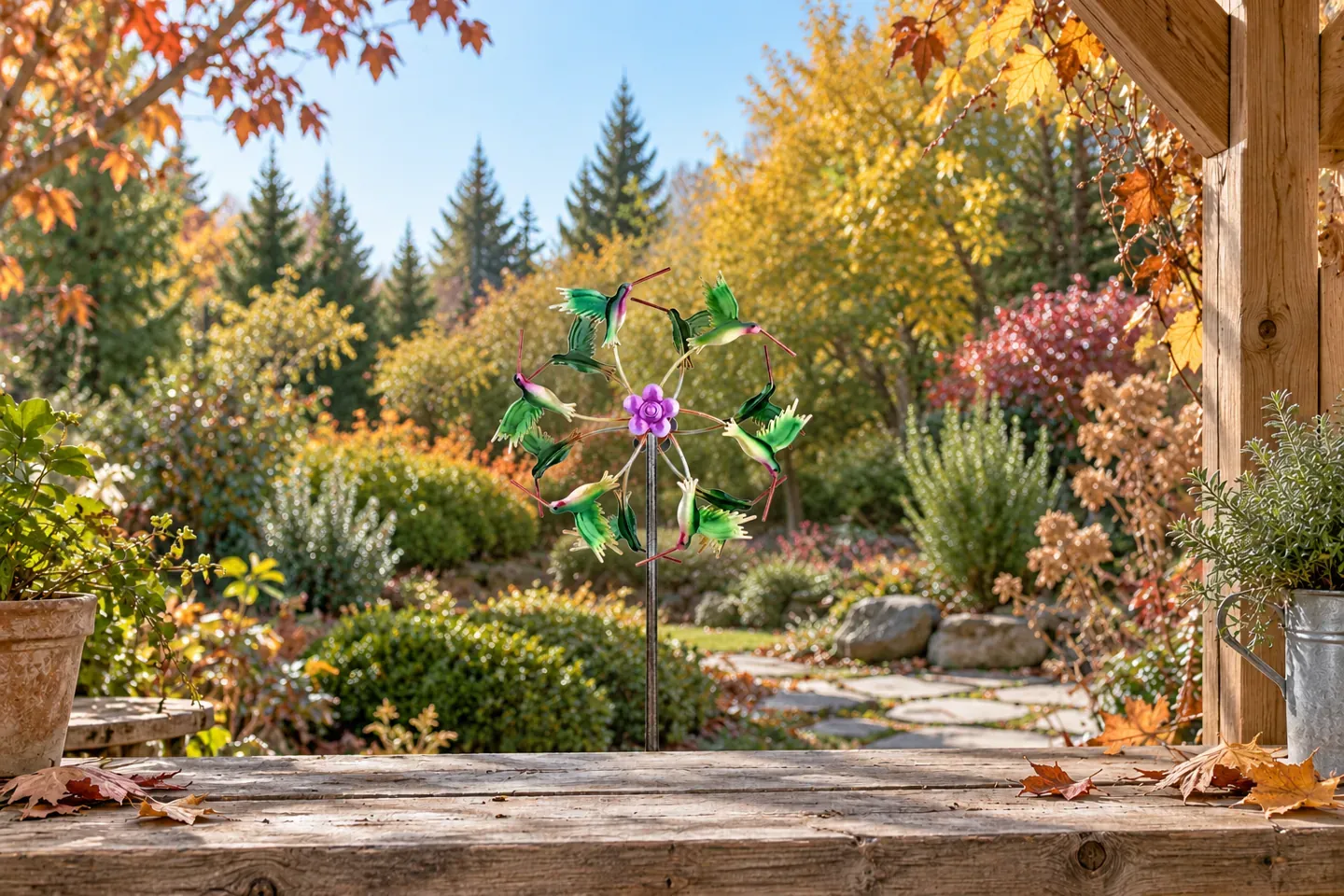
The Mloarts A211 hummingbird metal garden wind spinner is described as a wind-driven iron ornament with a removable pole. That description does not establish a minimum starting wind speed or a severe-weather rating.
Do not invent either figure, and do not test the spinner with a powered blower or expose it to stronger weather to force a result.
Look for contact with plants and decorations
From a safe position, check whether leaves, branches or neighboring objects are touching the moving section. In a garden entering autumn, fallen material and changes to surrounding planting make this a useful seasonal check.
Follow the handling instructions before removing debris or moving the ornament. Keep hands clear of parts that may begin to move, and do not work on it in gusty conditions.
If clearance cannot be maintained in its current location, ask the supplier about suitable placement rather than bending the rotor or changing the design.
Compare the assembly with the instructions
Use the diagrams and parts list supplied for your model. Check the stated orientation and connection sequence. If a part looks different from the instructions, stop and ask for clarification.
Do not loosen an unknown fastener simply because another brand recommends doing so. Likewise, adding oil, magnets, washers or replacement components changes the original arrangement and may be inappropriate.
Visible distortion, a loose connection or a part that appears to be missing is a reason to contact the supplier. It is not a prompt to reshape the item by trial and error.
Record what happens when conditions change
If the product instructions allow repositioning, observe it in another suitable location under ordinary conditions. Make a note of the original location and what changed so the comparison is useful.
A brief video showing the complete spinner, its surroundings and the behavior you are reporting can be more informative than a close-up of the center alone. Do not handle moving parts to create a demonstration.
Keep the model reference, assembly instructions and relevant photographs together. Describe what you observed without guessing which component has failed.
Ask for model-specific support
When reviewing moving ornaments alongside other metal garden statues, keep their care and movement requirements separate. Advice for a static statue does not establish how a rotor should be adjusted.
For a Mloarts product, contact the team with the SKU and a description of the issue. Request the current instructions and an approved next step. Clear observations help the supplier respond without relying on an improvised repair that may create another problem.