Oct 20, 2026How to art
How to Choose Metal Home Statues for Your Space
Choose metal home statues that suit your room. Compare size, silhouette, color, placement, and practical details for a balanced, personal display.
How to Choose Metal Home Statues for Your Space
The right home statues bring personality to a room without making it feel crowded. A slender musician, a playful animal, or an abstract figure can become a focal point—but only when its size, shape, and placement suit the space.
Choosing well starts with the room, rather than the product photograph. Before buying, consider where the sculpture will stand, how you will view it, and what will surround it.
Start With the Display Location
A sculpture on an entryway console has a different job from one placed among books or beside a reading chair.
Choose the location first, then measure:
- Available surface width and depth.
- Clearance beneath shelves or wall-mounted furniture.
- Space around lamps, plants, and framed pictures.
- Distance from table edges and busy walkways.
For living room statues, check the display from your usual seat as well as the doorway. A figure that looks impressive close up may disappear against a busy background.
Measure the Whole Sculpture
Height alone does not tell you whether a piece will fit.
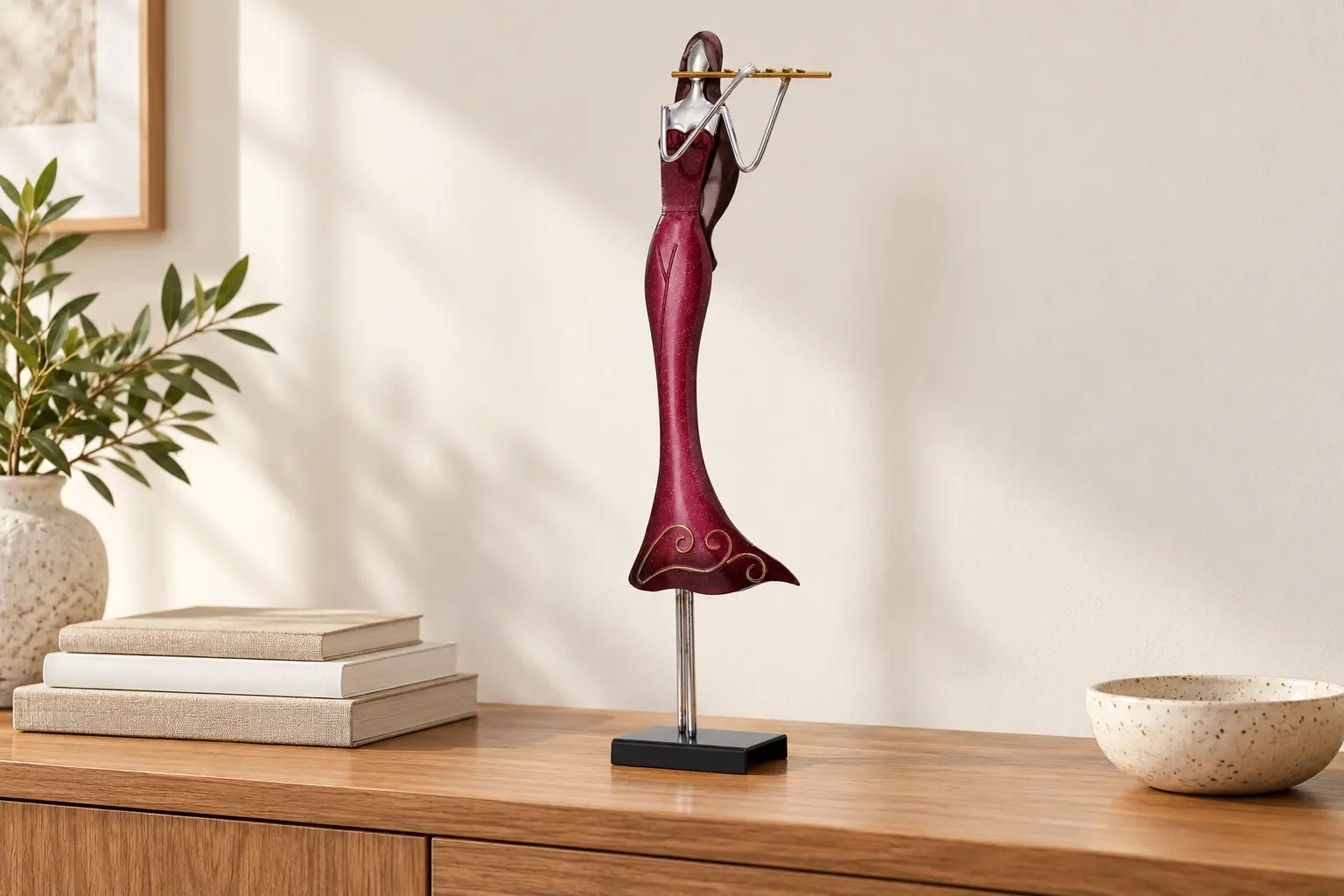
The supplied flute-player figure, for example, has a slender body, a rectangular base, and an instrument extending sideways. Its overall width includes the flute, while its stability depends on details that a front photograph cannot fully establish.
Before selecting a home decor statue, request the overall height, width, depth, base dimensions, and weight.
Match Visual Weight to the Room
Two decorative statues of the same height can have very different visual effects.
A broad, solid-looking form may feel substantial. A slender figure with open space around its arms can appear lighter and more delicate.
Display setting | Sculpture direction to explore |
|---|---|
Narrow console | A slim figure with a suitable base |
Deep bookshelf | A clearly defined silhouette |
Large sideboard | One substantial sculpture or a spaced group |
Compact apartment | A small statue for home decor with a clear outline |
Quiet reading corner | A personal subject with restrained colors |
Modern statues for home do not need to be large or abstract. A simplified musician figure can introduce a contemporary shape while still reflecting a familiar interest.
Choose a Subject That Means Something
The most convincing statues for home decor often connect with the owner’s interests.
A flute-player sculpture might suit someone who performs music, enjoys concerts, or wants a decorative accent for a listening room. An animal figure might reflect a favorite pet or a longstanding collection.
This connection gives decorative sculptures for home a purpose beyond filling an empty surface.
Explore Mloarts’ metal home sculptures with a recipient or room in mind. Confirm individual product details before deciding where a piece belongs.
Consider the Mood of the Figure
Look at posture, expression, and movement.
An upright musician can create an elegant, composed feeling. A humorous animal can make the room more playful. An abstract form may work when you want shape and texture without a literal story.
Choose the mood you want to encounter every day.
Connect Color and Finish With Existing Decor
The supplied musician combines a burgundy dress, silver-toned arms, a gold-toned flute, and a dark base.
Those visible colors suggest several styling possibilities:
- Burgundy beside warm neutral upholstery.
- Silver-toned details against a darker background.
- Gold-toned accents near warm wood.
- A dark base on a light surface for definition.
These are styling directions, not material descriptions. A gold-colored instrument is not necessarily made from gold or brass.
For home decor statues with multiple finishes, repeat one accent elsewhere in the room rather than trying to match every color.
Give the Sculpture Space
Home sculptures need enough room for their outline to remain readable.
Try pairing one figure with a short stack of books and a lower object. Avoid placing a tall vase directly in front of an instrument or expressive detail.
For groups of decorative sculptures, vary height while keeping a connection through color, subject, or material.
An empty area beside a sculpture can be just as useful as another accessory.
Check Stability, Surfaces, and Care
Before placing a statue at home, inspect the base and any projecting details.
Confirm:
- The base sits securely on the intended surface.
- The furniture can support the item.
- The underside will not scratch the finish.
- Delicate parts are clear of curtains and passing movement.
- Cleaning instructions suit the painted or metallic finish.
Keep decorative figures away from positions where they may be easily knocked. Do not assume that a decorative sculpture is a toy or that an indoor finish is suitable outdoors.
Your Final Home Statue Checklist
Choose sculptures for home decor by asking:
- Does the complete piece fit the available space?
- Will its silhouette remain visible?
- Does the subject feel personal?
- Do its colors connect with the room?
- Are the base, finish, and care requirements clear?
Well-chosen home statues add character while leaving the room comfortable to use.
Browse suitable designs, then contact Mloarts about sculpture dimensions and finishes before completing your selection.