Oct 20, 2026How to art
How to Choose Metal Garden Statues for Your Space
Find metal garden statues that suit your outdoor space. Check scale, stability, finish, plant combinations, placement, and seasonal care before buying.
How to Choose Metal Garden Statues for Your Space
Metal garden statues can give an outdoor space a recognizable focal point. A rooster beside a planter, a bird near a path, or an abstract form among grasses can add interest beyond the flowering season.
However, appearance is only one part of the decision. The right piece also needs to suit the available space, installation surface, exposure, and maintenance routine.
Start with where it will stand.
Decide What the Sculpture Should Do
Before comparing metal garden sculptures, give the piece a clear role.
It might:
- Welcome visitors near an entrance.
- Draw attention at a bend in a path.
- Add height beside low planting.
- Bring character to a patio.
- Create a view from an indoor window.
A sculpture with a defined position is easier to choose than an ornament bought first and placed later.
The Royal Horticultural Society’s garden border planning guide considers scale, color, planting height, and site conditions. Those factors also provide useful context when placing garden art.
Choose Scale for the Viewing Distance
Large metal garden statues need room around them. Smaller metal garden figures need a background that allows them to remain visible.
Measure the intended area and consider the plants at their mature height—not just their size today.
Look Beyond Overall Height
Check the sculpture’s:
- Full width, including tails, wings, or branches.
- Base footprint.
- Depth and projecting details.
- Position relative to paths and seating.
- Appearance from the main viewing point.
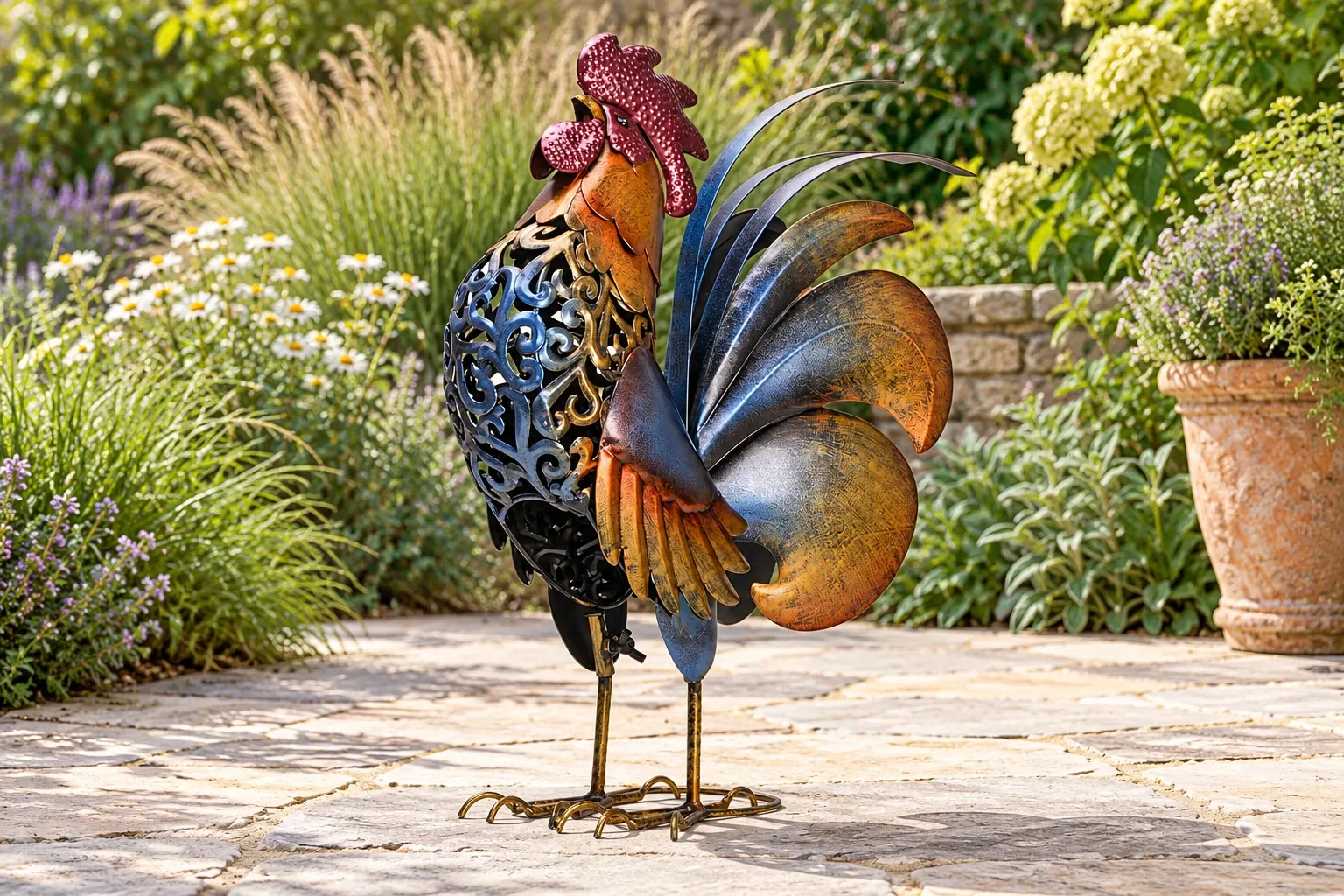
The supplied rooster has a rounded openwork body, curved tail feathers, slender legs, and a low supporting frame. Its tail contributes substantially to the outline, so height alone would not explain its space requirements.
A photograph does not establish the product’s actual dimensions or outdoor suitability.
Match the Base to the Surface
Outdoor metal statues may stand on paving, decking, gravel, or soil. Each surface presents different installation questions.
Intended surface | What to confirm |
|---|---|
Paving or concrete | Base contact, fixing options, and surface protection |
Garden soil | Ground support and the specified securing method |
Gravel | Whether there is a suitable firm support beneath |
Decking | Structural suitability and approved fixing arrangements |
Raised display area | Stability, edge clearance, and installation advice |
Do not assume that weight alone guarantees stability.
For tall, broad, or exposed metal yard statues, request product-specific anchoring guidance. If the intended site falls outside that guidance, obtain appropriate installation advice.
Check Materials and Outdoor Protection
Iron garden sculptures and steel garden statues can have different constructions and protective treatments.
Descriptions such as “metal,” “iron,” and “tin garden statues” should not be treated as interchangeable material specifications.
Before buying, ask:
- What is the actual metal?
- What protective finish is applied?
- Are joints, edges, and the underside treated?
- Can any cavities retain water?
- What exposure and care instructions apply?
“Outdoor suitable” does not automatically mean suitable for immersion, coastal salt exposure, or every climate.
When comparing metal garden sculptures for sale, look for clear specifications rather than broad promises such as “rustproof forever.”
Use Color and Silhouette Together
A garden sculpture should work with its background.
The supplied rooster combines dark openwork, blue-toned surfaces, warm gold and copper colors, and a red comb. Its open areas allow the background to become part of the design.
Against dense, highly patterned planting, those details may become harder to distinguish. A simpler backdrop can help.
Create Contrast Without Adding Clutter
Consider these combinations:
- Dark metal garden ornaments against pale stone.
- Blue-toned details beside warm autumn foliage.
- Copper colors near terracotta planters.
- A red accent within predominantly green planting.
- A clear animal silhouette beside fine ornamental grasses.
For metal garden decor with several colors, keep nearby pots and accessories relatively simple.
One well-positioned sculpture can create more impact than many unrelated ornaments.
Match the Style to the Garden
Metal garden statuary can be playful, traditional, contemporary, or abstract.
An ornate rooster may suit a country-inspired patio or cottage garden. A simplified form may connect more easily with a modern courtyard.
Mloarts’ metal garden statues collection provides designs to explore. Check each model’s intended environment before selecting a location.
The same visual idea can work in a US yard, UK courtyard, European terrace, or Australian outdoor living area. Local conditions still need separate assessment.
Plan for Weather and Seasonal Care
Outdoor garden sculptures need care appropriate to their material and finish.
Ask whether the product should be moved during severe weather, stored in freezing conditions, or checked periodically at its fixing points.
Keep leaves and debris from collecting around bases. Follow the supplier’s cleaning instructions and ask for advice if the finish becomes damaged.
Avoid placing metal garden decorations where irrigation repeatedly wets them unless that exposure is suitable for the product.
Choose With the Whole Garden in Mind
Before ordering metal garden statues, confirm that the piece:
- Has a clear purpose and viewing position.
- Fits the planting and available space.
- Can be secured appropriately.
- Has documented outdoor suitability.
- Complements the garden’s colors and materials.
- Comes with practical care guidance.
The best fit is a sculpture that looks connected to the garden and can be placed there with confidence.